Piezoelectric materials convert mechanical stress into electrical signals and back, a property that underpins self-powered biosensors, implantable energy harvesters, and flexible bioelectronic devices. Synthetic polymers such as polyvinylidene fluoride, PVDF, and inorganic oxides like ZnO dominate current applications, but their limited biocompatibility and poor molecular programmability motivate the search for alternatives. Peptide assemblies offer an attractive route: their intrinsically dipolar backbones, tunable noncovalent interactions, and well-defined one-dimensional nanostructures can, in principle, support the non-centrosymmetric dipolar alignment that piezoelectricity requires. The challenge has been achieving and controlling that alignment, because morphological order alone does not guarantee functional activity.
Researchers in the Ghosh Group at the Centre for Nano and Soft Matter Sciences, Bengaluru, and the Sengupta Group at the Indian Institute of Science Education and Research, IISER, Kolkata, published in Angewandte Chemie International Edition, designed a pyrene-conjugated tetrapeptide, PEP-A, incorporating aspartic acid and phenylalanine residues and assembled it under varied solvent conditions. They characterized the resulting structures by UV-Vis, photoluminescence, circular dichroism, FT-IR, atomic force microscopy, and scanning electron microscopy, then correlated those structural findings with piezoresponse force microscopy measurements. Atomistic molecular dynamics simulations in pure water and in 1:9 cosolvent/water mixtures provided mechanistic insight into how solvent composition reshapes intermolecular packing and dipolar organization.
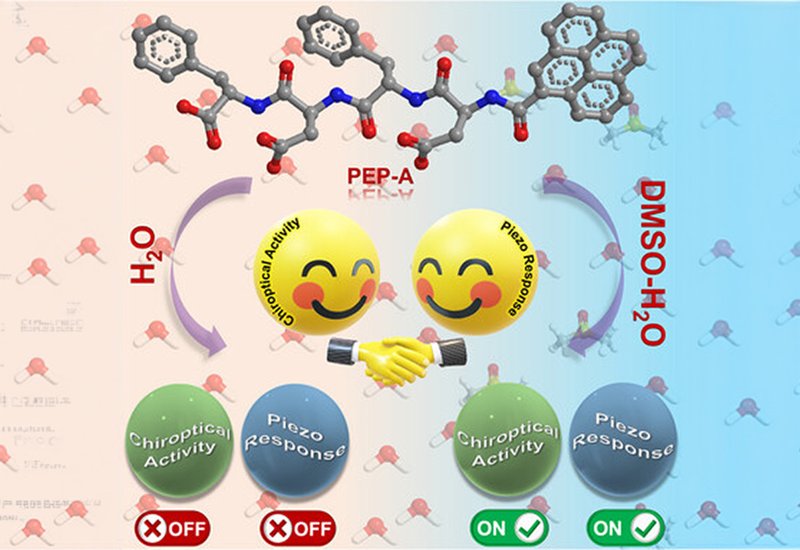
In pure water, PEP-A forms elongated, micrometre-long entangled nanofibers roughly 1.5 nm in height and 30 nm in width, stabilized by cooperative π–π stacking and hydrogen bonding. Denaturation analysis fit to the nucleation-elongation model returned a Gibbs free energy of assembly, in water, of −50 kJ mol⁻¹ at 0.1 mM, confirming high thermodynamic stability. Yet despite strong aggregation, these fibers show no Cotton effect in circular dichroism and no measurable piezoelectric response by piezoresponse force microscopy: a flat phase-voltage trace and featureless amplitude loop. Molecular dynamics simulations rationalized this inactivity: the parallel-stacked arrangement is statistically dominant relative to the antiparallel alternative due to strong internal stabilization, but its dipole fluctuations are large and the local curvature difference between the pyrene-facing and amide-facing sides of the stack oscillates without converging to a stable value.
Introducing as little as 1% DMSO or 1% DMF transforms both properties simultaneously. Circular dichroism spectra acquire a strong negative Cotton effect, signaling transfer of molecular chirality to the supramolecular level through ordered helical packing. Piezoresponse force microscopy reveals a butterfly-shaped amplitude loop and a ~180° phase shift, the hallmarks of a piezoelectrically active, non-centrosymmetric assembly. The piezoelectric coefficient d33 reaches 29.5 ± 1.4 pm V⁻¹ at 1% DMSO, comparable to benchmark values for PVDF and ZnO. Both the circular dichroism signal and the piezoresponse persist up to 20% cosolvent, then decline as the assembly begins to dissolve beyond 30%. Molecular dynamics simulations of the cosolvent system show that DMSO suppresses dipole-moment fluctuations by roughly 38%, lowers the effective dielectric constant by approximately 45%, and stabilizes local curvature asymmetry, consistent with the helical, non-centrosymmetric arrangement responsible for the measured piezoresponse. The DMF system reproduces all key metrics, with d33 of 28.8 ± 1.2 pm V⁻¹ at 1% DMF, confirming that the effect is a general consequence of polar aprotic cosolvent action rather than a property specific to DMSO.
This work establishes supramolecular chirality as a prerequisite for piezoelectric functionality in peptide assemblies and demonstrates that cosolvent composition is a practical dial for switching that functionality on or off without altering fibrillar morphology. The finding that trace amounts of a polar aprotic cosolvent suffice to activate a piezoresponse approaching that of established synthetic materials opens a design route toward fully biocompatible, molecularly programmable piezoelectric nanomaterials. Potential applications include soft sensors, implantable mechanical-to-electrical energy converters, and next-generation bioelectronic interfaces where biodegradability and structural tunability are required alongside competitive electromechanical performance.